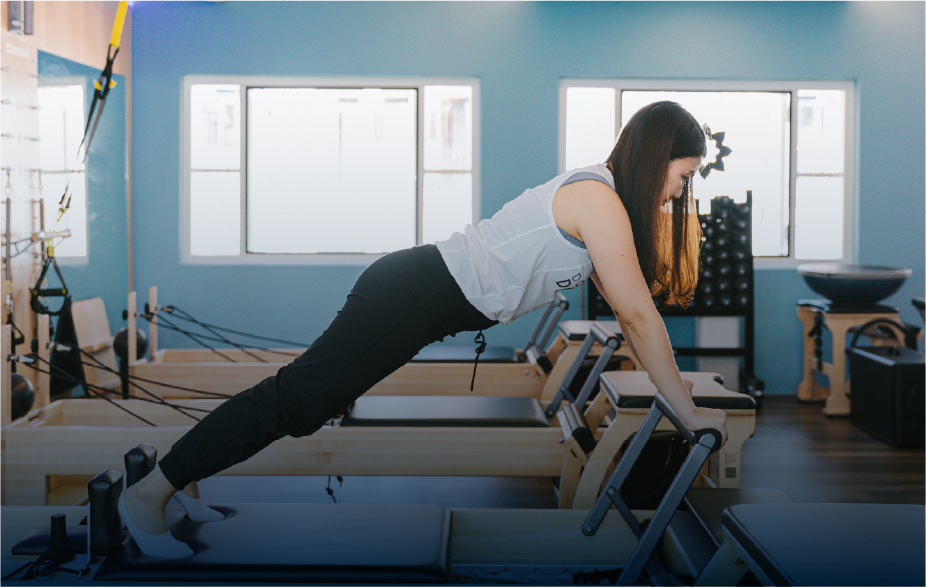
Most people who have never used a reformer assume it is a complicated version of a gym machine.
It is not.
The reformer is a fundamentally different exercise tool. The physics of how it loads the body are categorically distinct from free weights, cable machines or resistance bands. And for specific populations, particularly post-rehabilitation patients, older adults and desk workers with movement dysfunction, those physics produce outcomes that conventional gym equipment genuinely cannot.
Reformer pilates Singapore is growing precisely because the fitness market is finally catching up to what physiotherapists have understood for decades.
The Physics Problem With Free Weights
Free weights load the body through gravity.
Simple, effective, time-tested. But gravity only pulls in one direction: down.
This means free weight exercises can only load muscles that work against the vertical direction of that pull. A dumbbell bicep curl loads the elbow flexors because they resist the downward pull on the weight. A squat loads the knee and hip extensors because they resist the downward pull on the body.
Muscles that work in other directions — laterally, diagonally, in rotation — are not effectively loaded by free weights without elaborate positioning and equipment.
The reformer changes this completely.
How Spring Resistance Creates a Different Loading Environment
The reformer’s spring system attaches between the moving carriage and the frame at a position that changes relative to the body as the carriage moves.
This creates a resistance vector that is not fixed to vertical. Depending on the exercise, the spring resistance can load the body horizontally, diagonally or in patterns of rotation and combination that gravity-based equipment cannot produce.
More importantly, the spring resistance is accommodating rather than fixed.
With a free weight, the resistance is constant regardless of where in the movement range you are. If you are in a mechanically weak position, the weight does not reduce. If you are in a mechanically strong position, it does not increase. You fight the same resistance throughout.
Springs do not work this way.
Spring resistance increases as the spring lengthens and decreases as it shortens. This means the resistance profile across a movement range can be specifically calibrated to match the body’s changing mechanical advantage. In positions where the body is mechanically weak and injury risk is higher, spring resistance is lower. In positions where the body is mechanically strong, resistance is higher.
This accommodating resistance is not a feature that makes the reformer easier. It is a feature that makes it safer for specific populations while simultaneously allowing more targeted loading of specific muscle groups at specific joint angles.
The Eccentric Loading Advantage
Here is what most people do not know about the reformer.
It excels at eccentric loading in a way that free weights and most gym machines do not.
Eccentric muscle contraction occurs when a muscle produces force while lengthening. Landing from a jump, lowering a weight slowly, braking during downhill running. Eccentric capacity is the primary determinant of injury resilience in most sports and activities.
It is also the hardest type of strength to train safely, because eccentric exercises in conventional gym settings load the muscle maximally at the point of greatest length and greatest injury vulnerability.
The reformer’s spring system allows eccentric loading to be progressed gradually from very low resistance to increasingly demanding loads, because the spring resistance decreases as the muscle lengthens (as the carriage returns to its start position). The practitioner can therefore work through high-velocity eccentric patterns with controlled, appropriate resistance rather than the fixed loads that make eccentric gym training genuinely risky for rehabilitation populations.
This is why Singapore’s physiotherapists recommend reformer pilates for post-surgical rehabilitation. The eccentric loading capacity it provides in a safe, controllable environment has no equivalent in conventional gym settings.
The Proprioceptive Dimension
The reformer carriage is an unstable surface.
Not dramatically unstable — it does not oscillate randomly. But it requires constant proprioceptive adjustment to control its position during exercises.
This instability demand recruits the deep stabilising muscles of the trunk and the small postural muscles of the hip, shoulder and ankle that conventional gym machines, which guide movement through fixed ranges on stable surfaces, systematically fail to challenge.
For desk workers with inhibited deep stabilisers from years of sedentary positions, for post-surgical patients whose neuromuscular control has been disrupted by injury and recovery, and for older adults whose proprioceptive systems need specific challenging to maintain fall prevention capacity, this proprioceptive demand is not a complication. It is a primary therapeutic benefit.
Yoga Edition designs its reformer programming around these biomechanical principles, ensuring that each session delivers the specific loading benefits that make the reformer clinically distinct rather than simply different-looking from conventional exercise equipment.